

Nepal has approximately 15-20 years to capitalize on a rare economic opportunity that took seven decades to create. The country's population structure has reached an ideal configuration: a peak proportion of working-age adults supporting fewer dependents than ever before. But this advantage is temporary and already beginning to erode.
Nepal's workforce has reached its historical peak. In 2021, 65% of Nepal's population fell into the working-age category (15-64 years), the highest share in the country's recorded history. Compare this to 1952, when working-age adults made up just 58% of the population while children under 15 comprised 39%. Today, children represent only 28% of the population.
It's the demographic sweet spot that can power the economic transformation. More workers, fewer young dependents to support, and the potential for higher savings, investment, and per capita income growth.
But the chart also reveals the coming challenge: the 65+ population, while still small at 7%, is the fastest-growing segment and will accelerate in the coming decades.
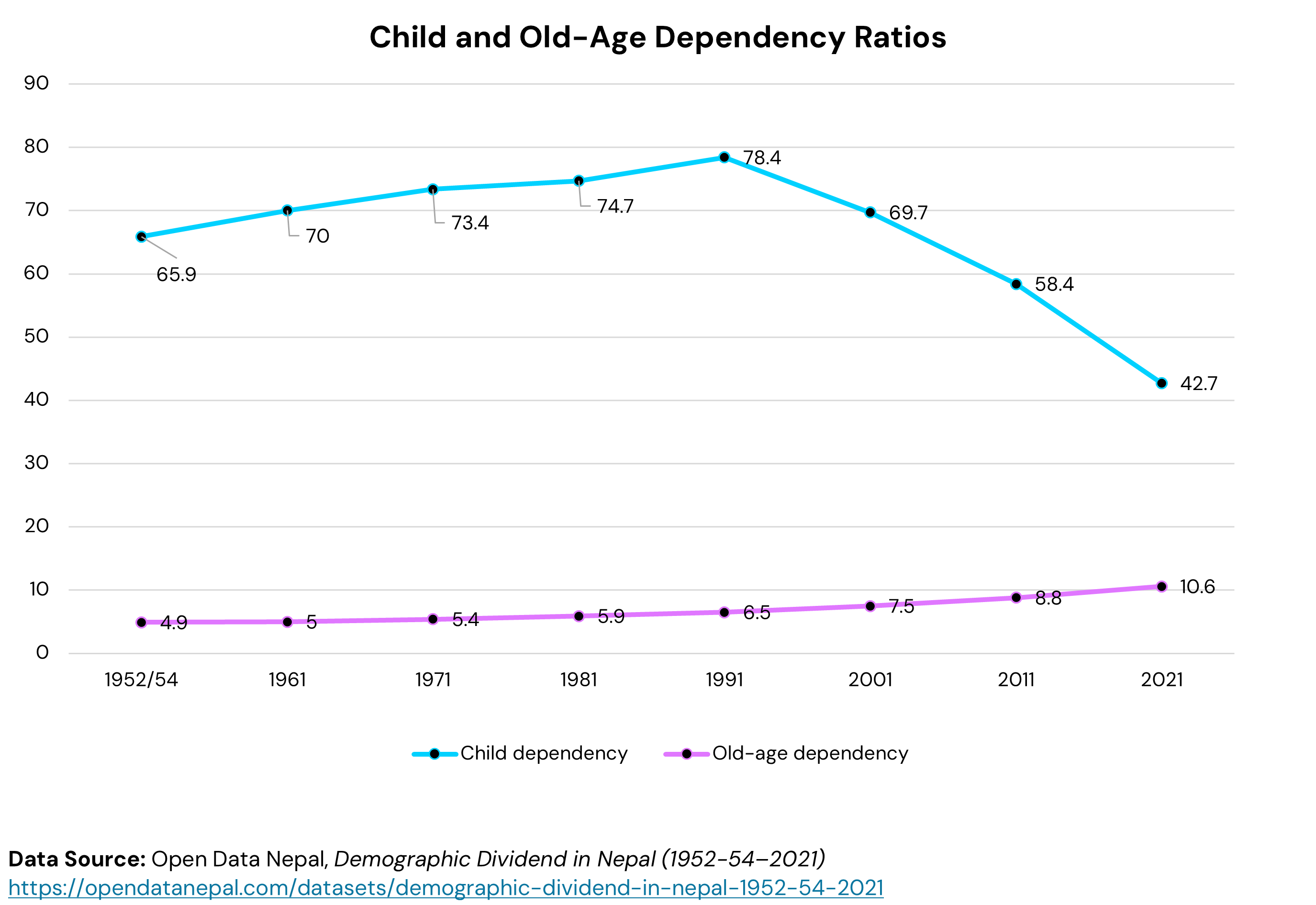
The dependency burden has been lighter and positive, but it won't last for a long time. For every 100 working-age Nepalis in 2021, there are just 53 dependents to support. Down from 70 dependents in 1952. This 24% reduction in the dependency ratio represents the core of Nepal's demographic dividend.
The breakdown tells two interesting stories simultaneously:
- Child dependency has plummeted from 66 to 43, the result of a dramatic fertility decline that has reduced the number of young dependents requiring education, healthcare, and support.
- Old-age dependency has more than doubled from 5 to 11—a harbinger of challenges ahead as life expectancy improves and the population ages.
The gap between these two lines represents Nepal's window of opportunity. As they converge in the coming decades, the demographic advantage will disappear.
The workforce is expanding while the dependent population shrinks.
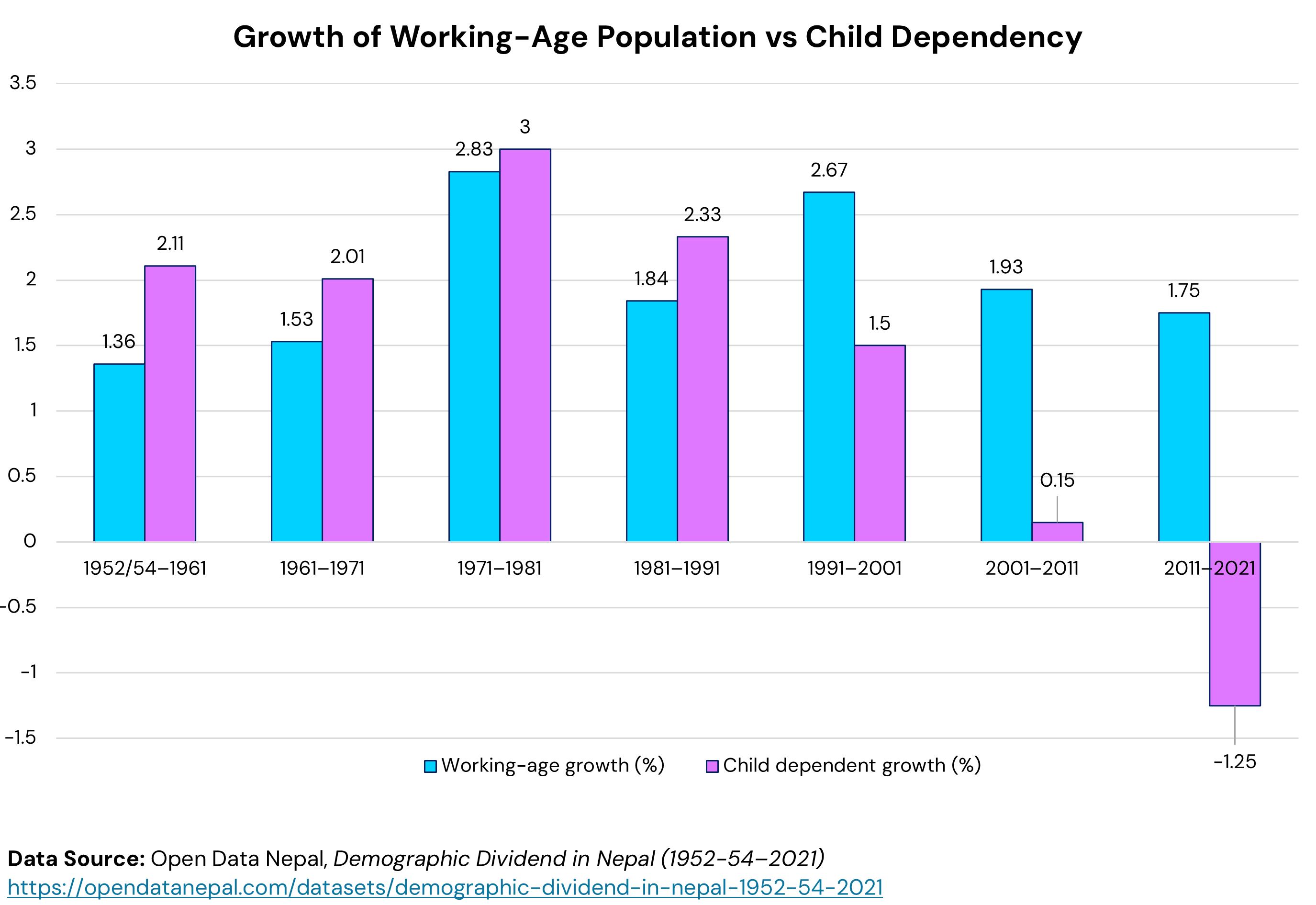
Between 2011 and 2021, Nepal's working-age population grew at 1.75% annually, while the child-dependent population actually declined by 1.25%. This situation creates favorable conditions for economic acceleration.
Population growth trends further reinforce this demographic shift. Across census periods, the working-age population has generally grown faster than the dependent population. Between 2011 and 2021, child-dependent population declined by 1.25%, while the working-age population grew at 1.75%. This creates a favorable dependency structure, with more working-age individuals supporting fewer young dependents, which can potentially increase per capita income, savings, and investment if the workforce is productively employed.
The engine of change: a fertility collapse.
Nepal's crude birth rate has crashed from 47 births per 1,000 people in 1961 to just 14 in 2021, a 70% decline in six decades. Total fertility has dropped even more dramatically, from 5.7 children per woman to 1.9, now below the replacement rate of 2.1.
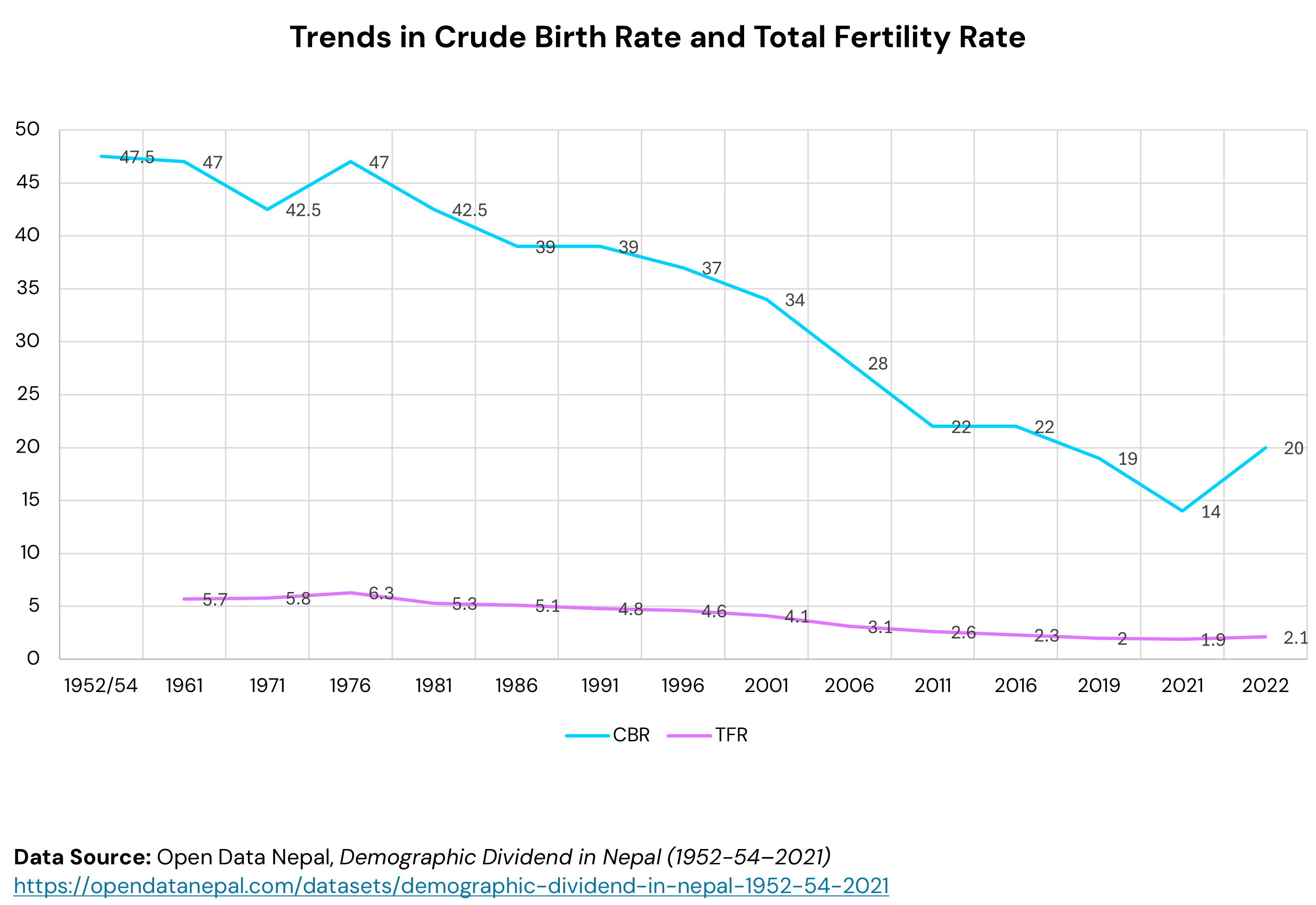
This fertility decline created today's demographic dividend by reducing the flow of children into the population. But it also guarantees that Nepal's workforce will eventually shrink and age. The same force that created the opportunity is already setting the stage for its end.
The Closing Window
Nepal now faces a test that many countries have confronted and that some have failed. South Korea, Thailand, and Vietnam leveraged similar demographic transitions into prosperity through massive investments in education, infrastructure, and industrial development. Other countries squandered their windows through corruption, poor governance, and failure to create productive employment, resulting in youth unemployment and mass emigration.
The demographic dividend is a finite resource with an expiration date. Nepal's window is closing not in decades, but in years, and the policies enacted over the next 5-10 years will significantly shape whether this demographic transition becomes an economic breakthrough or a missed opportunity.
About This Story
This story is based on the dataset “Demographic Dividend in Nepal (1952/54–2021)”, compiled from Nepal’s national population censuses and demographic surveys conducted by the Central Bureau of Statistics (CBS). The data were accessed through Open Data Nepal (ODN) and cover long-term trends in population structure, dependency ratios, fertility, and growth of the working-age population. The analysis focuses on understanding how demographic changes over seven decades have shaped Nepal’s current demographic dividend and the limited window of opportunity it presents for economic development.
