

For the average worker in Nepal, the last seventeen years have been a volatile balancing act between rising earnings and a relentless cost of living. While nominal wages have surged by over 320% since 2009, the "Real Wage Gap"—the difference between wage growth and inflation—reveals a story of lumpy progress and sudden erasures of purchasing power.
The Long-term View
Over the past 15 years, data from Nepal Rastra Bank Annual Reports reveal a clear upward trajectory for both cost of goods and salaries. However, worker salaries have generally outpaced the rising cost of consumer goods.
Our data has been divided into two groups based on a strategic weight correction carried out by the Nepal Rastra Bank in the year 2015/16. A correction is a moment when the government or statistical bureau resets the "base year" to 100 to reflect modern consumption patterns and to adapt to market changes.
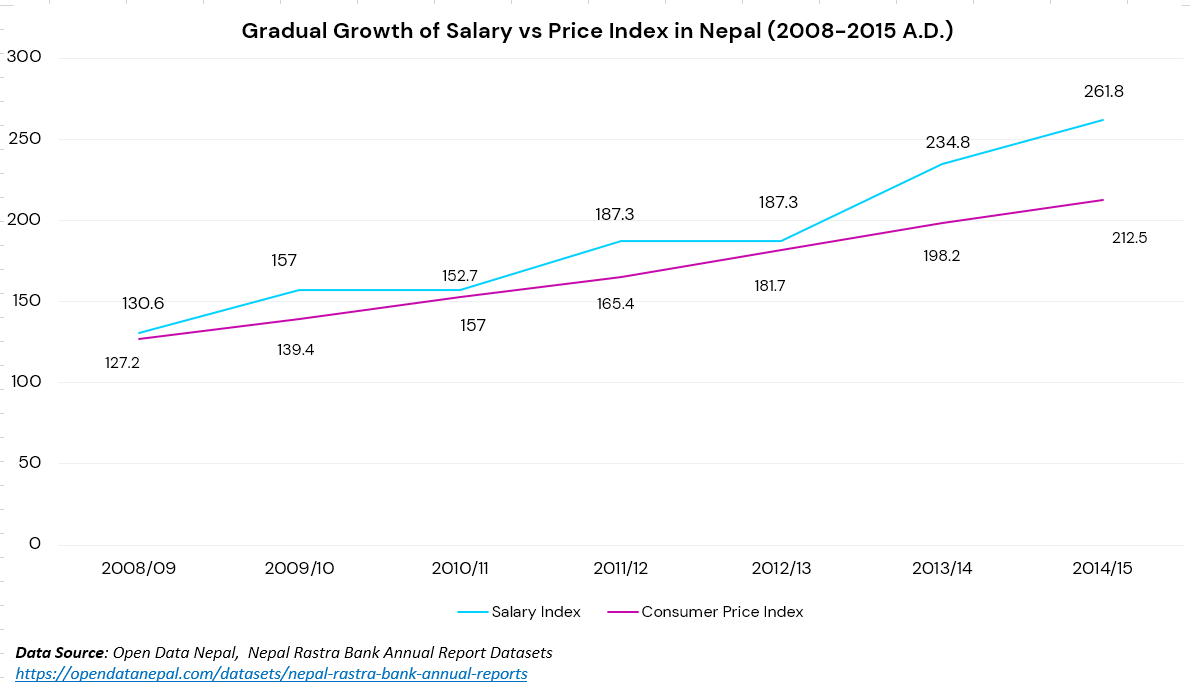
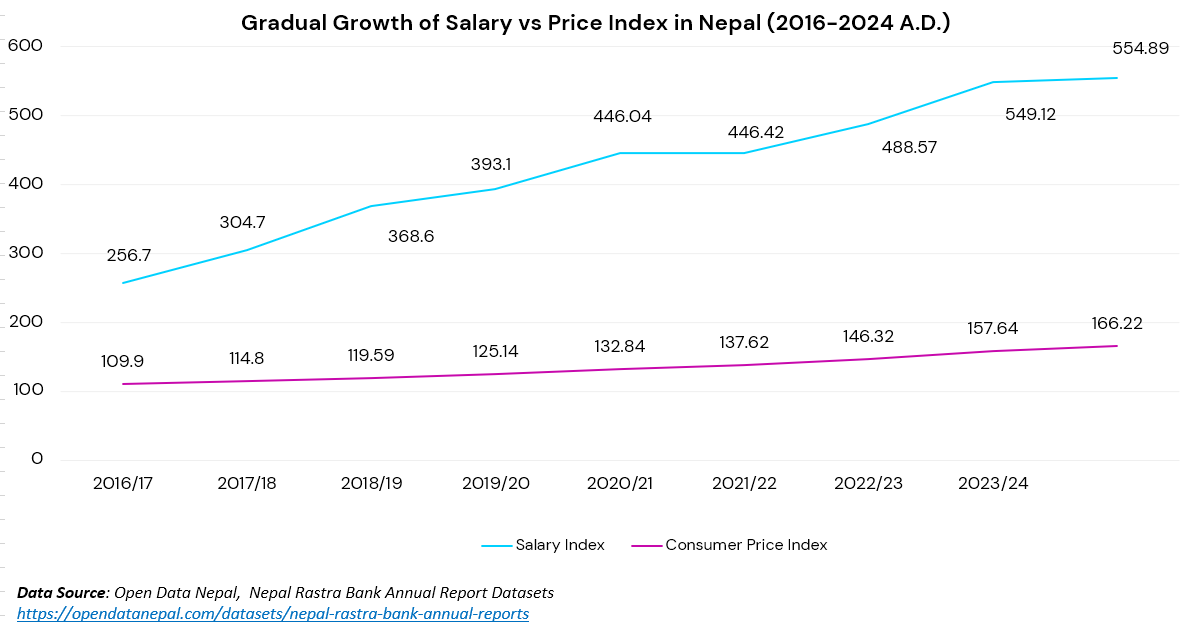
In the first phase ranging from 2008 to 2015, the index for price of goods grew by approximately 67% while the index for salaries doubled its value. After the statistical correction too, the trend of salaries outpacing consumer prices continued. The price index grew by 51% and the salary index grew by 116% between 2015 to 2024.
Though general overviews show wages are more powerful than inflation, data suggest some years may have been difficult than others. For example, from 2009 to 2011, we observed 19.1% increase in inflation and 20.2% increase in salaries. The year 2011 is marked as a time of significant depreciation of the Nepali Rupee against the US dollars, which is likely to have caused inflation to be that high.
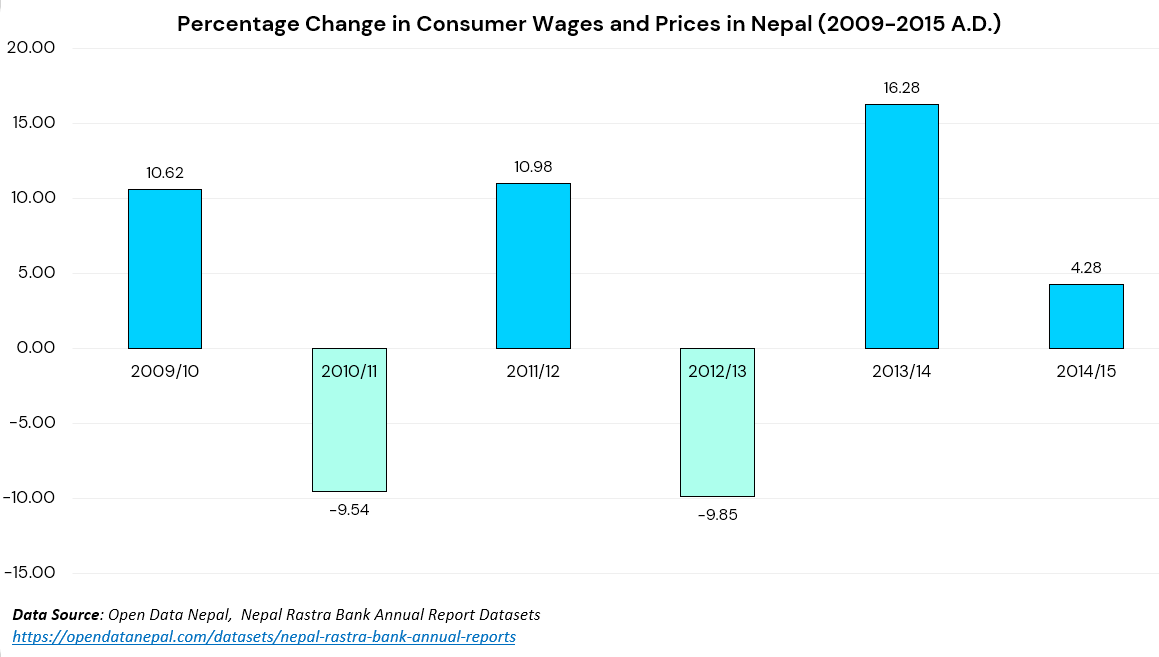
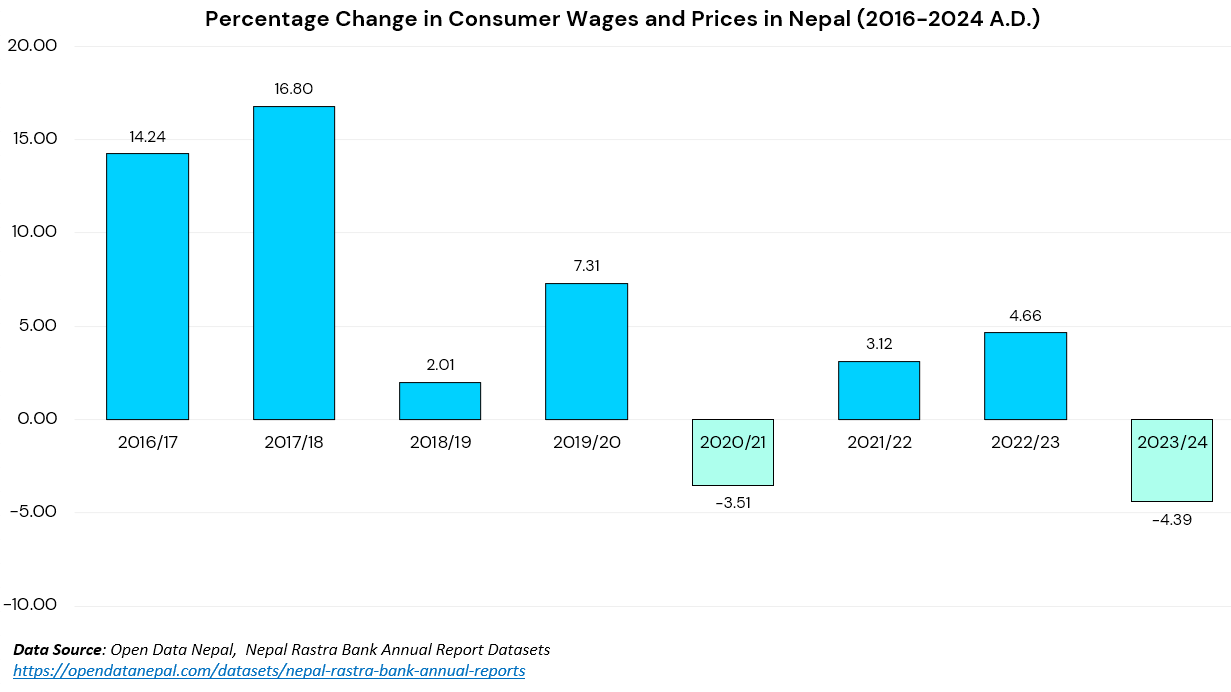
In Nepal’s history, wage growth has not been a steady climb but rather step-wise. Data suggests periods where there was no growth (0% growth in 2010/11 and 2012/13) followed by massive corrections, such as the 25% jump in 2013/14 and the 21% increase in 2017/18. This suggests that while inflation is a constant pressure, wages tend to catch up in significant, periodic bursts.
The Outlier Year: 2015/16
The year 2015/16 stands out as a massive statistical anomaly. The Consumer Price Index appears to "crash" by 48.28%, falling from 212.5 to 109.9.
| Year | 2014/15 | 2015/16 | 2016/17 |
|---|---|---|---|
| Consumer Price Index | 212.5 | 109.9 | 114.8 |
| Percentage Change | 7.21 | -48.28 | 4.46 |
In economic data, such a dramatic shift almost always indicates a re-basing of the index, which is a moment when the government or statistical bureau resets the "base year" to 100 to reflect modern consumption patterns.
Current Times
The most recent data (2022–2024) suggests a shift in discussions.
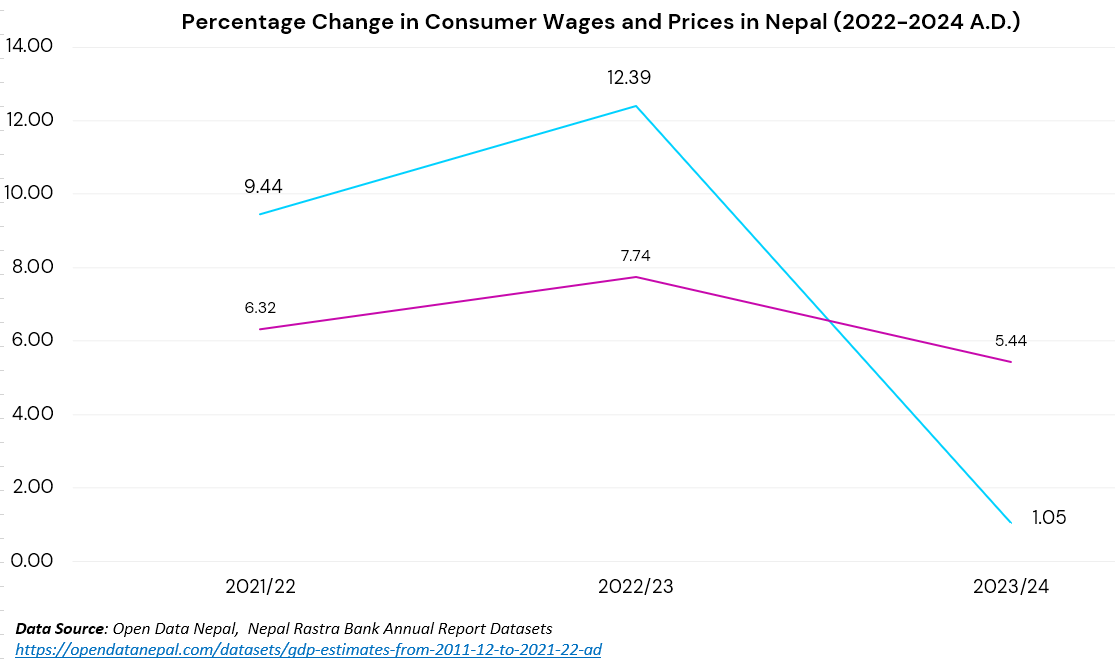
In 2022/23, inflation rate hit a multi-year high of 7.74%. While wages initially responded with a strong 12% increase, the following year (2023/24) shows a worrying divergence. Inflation remained on the top at 5.44%, but growth in salaries slowed to just 1.05%.
This indicates that the "cushion" workers enjoyed from previous high-growth years is currently being eroded. For the first time since the pandemic recovery began, the cost of living is rising significantly faster than take-home pay.
Conclusion
The long-term data provides a narrative of resilience, where wages have historically managed to leapfrog over inflation. However, analysis of the current times warns of a brewing challenge. With the latest wage growth stalling at near-zero levels while prices continue to climb by over 5%, the immediate outlook for 2024 suggests a period of tightness.
Historical patterns suggested a large wage correction may be necessary, so the Government of Nepal increased the minimum wage by 13% to NRs. 19,550 on July 15th 2025 in order to ensure stability.
